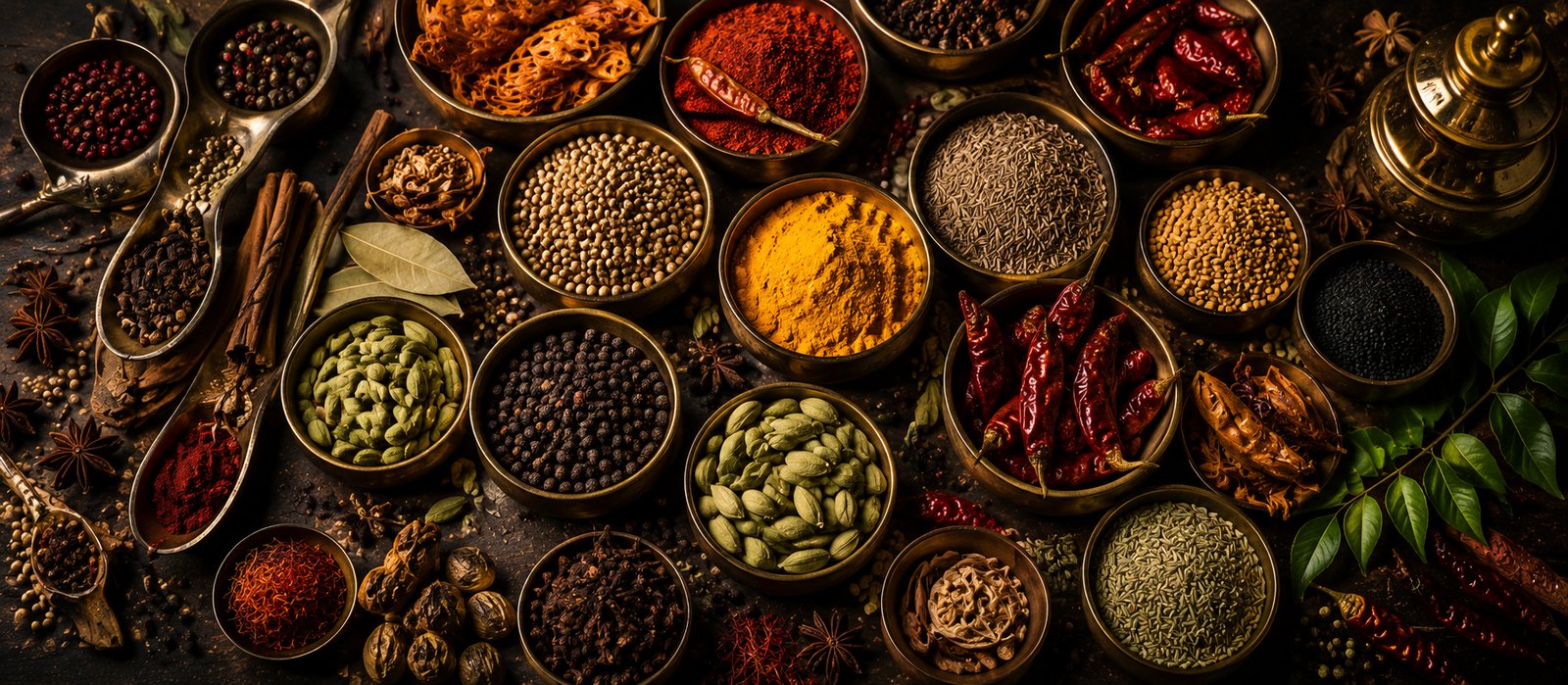
The golden spice
Turmeric — colour, health, and the science of curcumin
Turmeric is Indian cooking's most visually distinctive spice and one of the most scientifically studied food compounds on earth. Yet most cooks understand turmeric primarily as a colouring agent — underestimating its flavour contribution and misunderstanding what it actually does in a dish. Turmeric is not just colour: it is an antimicrobial, a flavour modifier, and a biochemical complex that behaves differently at different cooking temperatures.
The Science
What is curcumin and why does it make turmeric yellow?
Curcumin is a polyphenol compound that constitutes 2–5% of turmeric's dry weight. Its molecular structure contains a conjugated double-bond system that absorbs blue light and reflects yellow — producing the characteristic vivid colour. Curcumin is fat-soluble and photosensitive — it dissolves in cooking fat (which is why turmeric stains fat-containing surfaces) and degrades rapidly in sunlight (half-life of ~4 hours in direct sunlight). Cooking in fat maximises curcumin's colour contribution and its bioavailability — curcumin dissolved in fat is absorbed by the body 7× more efficiently than curcumin in water.
35 second read
What Turmeric Does in Indian Cooking
Beyond colour — four functions
- Colour: vivid yellow-orange from curcumin dissolving in cooking fat. The colour is pH-sensitive — acidic environments (lemon, tomato) shift it toward more orange; alkaline environments shift it toward yellow-red.
- Flavour: earthy, slightly bitter, mildly peppery. Turmerones (aromatic ketones in turmeric's essential oil) provide a warm, woody note underneath the curcumin's mild bitterness. Used in small quantities so flavour is background rather than dominant.
- Antimicrobial: curcumin and turmerones have demonstrated antimicrobial activity. Traditional Indian pickle universally uses turmeric — not just for colour but as a genuine preservative. This was empirically discovered thousands of years before microbiology.
- Protein interaction: turmeric affects protein structure during cooking — added to dal, it partially inhibits foam formation. Added to meat, it denatures surface proteins and affects texture. These are functional effects beyond flavour.